
2 pm, September 22, 2020
Invited Speaker:
Dr. Bill Phillips, Nobel Laureate,University of Maryland
Laurie Locascio, VP for Research; University of Maryland
Topic: Quantum Basics for the Curious: A Fireside Chat with Nobel Laureate Dr. Bill Phillips
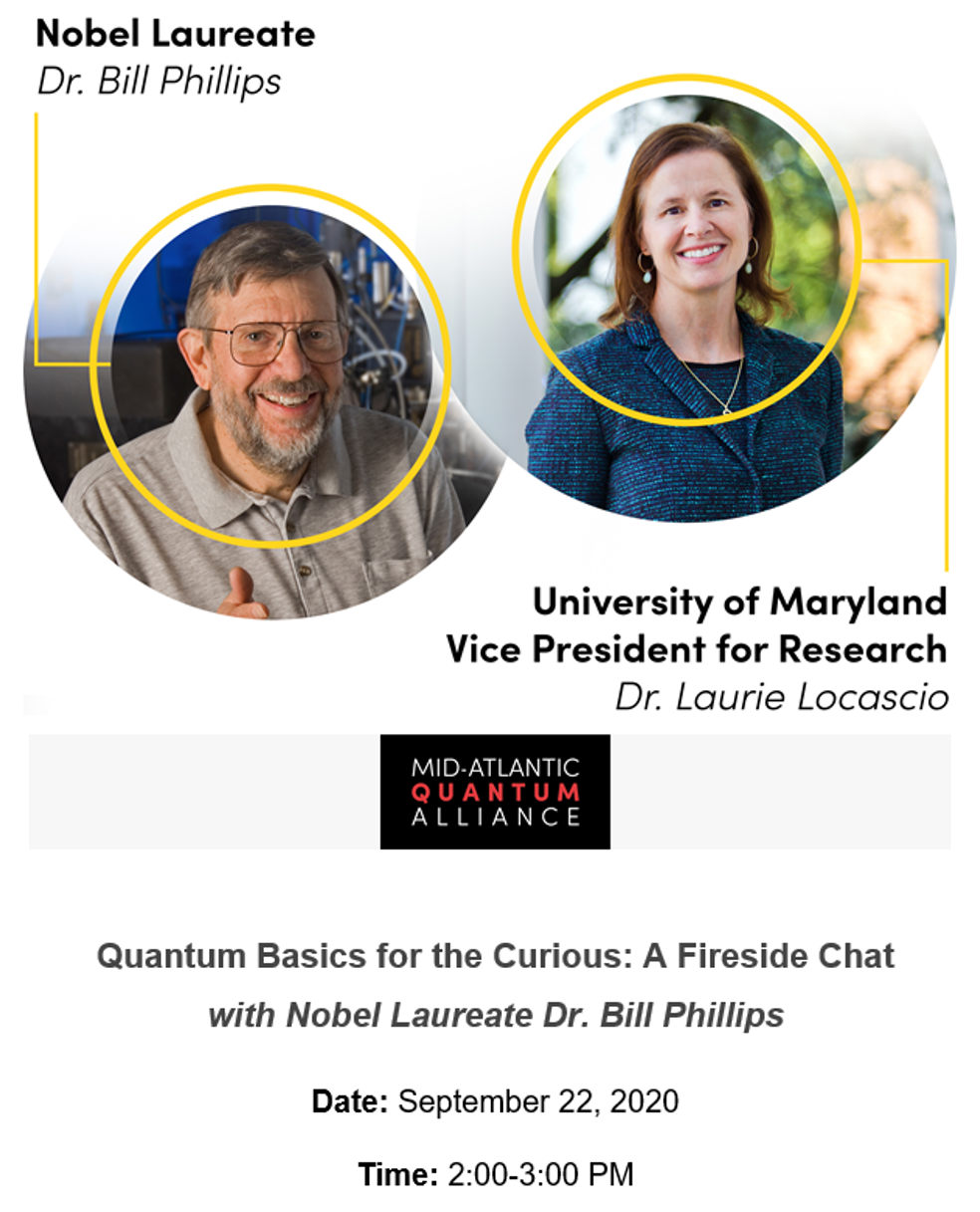
Topic: Quantum Basics for the Curious: A Fireside Chat with Nobel Laureate Dr. Bill Phillips
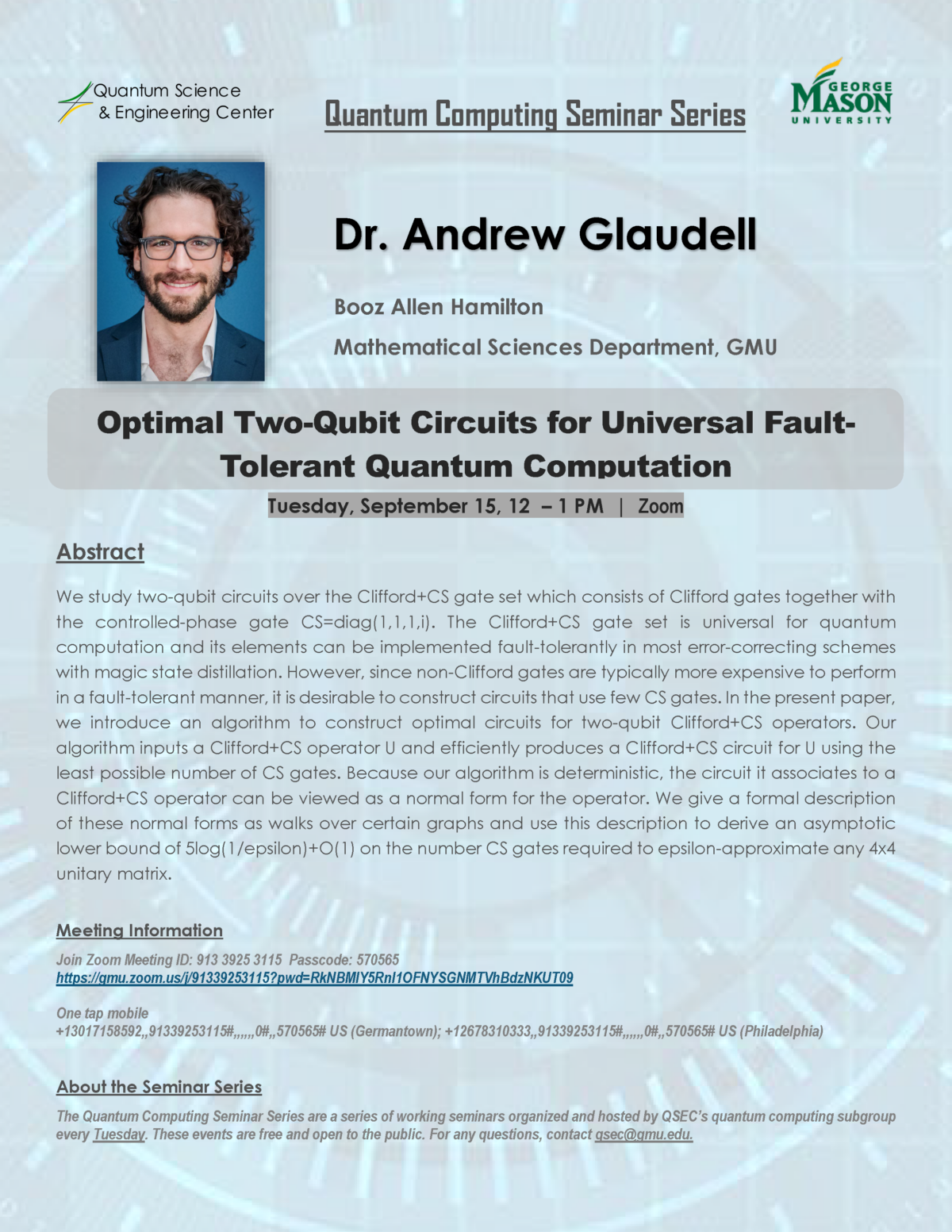
Topic: Optimal Two-Qubit Circuits for Universal Fault-Tolerant Quantum Computation
Location: Zoom
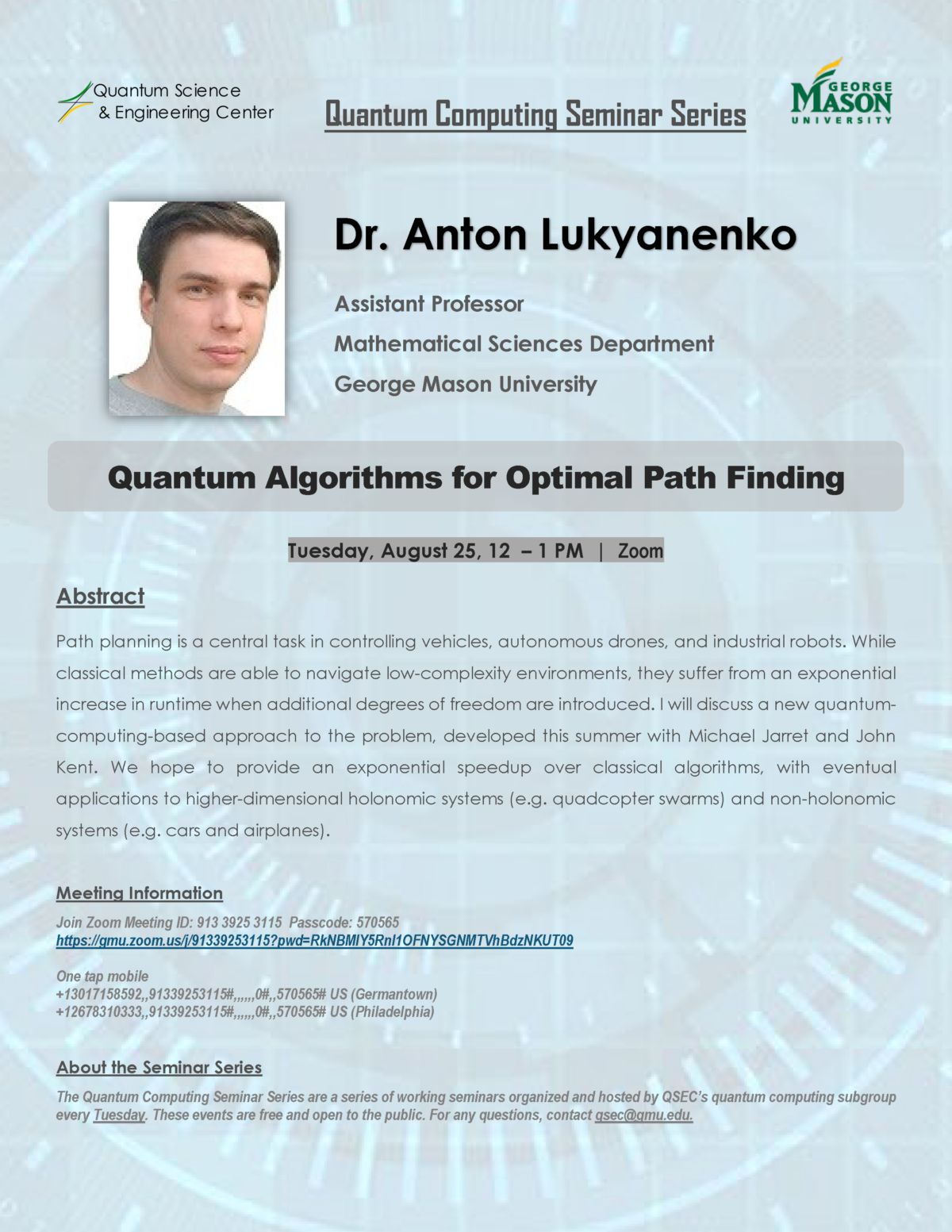
Topic: Quantum Algorithms for Optimal Path Finding
Location: Zoom

Mason’s Quantum Material Center (QMC), one of the four Transdisciplinary Centers for Advanced Study supported by the Provost Office of Research, is now officially Quantum Science and Engineering Center (QSEC).
QSEC was established in February 2018 and has grown beyond its roots as a materials science organization to a community of Mason scientists and engineers interested in advancing quantum technology. Our members focus on creating quantum algorithms for quantum computing, constructing ultra-sensitive quantum sensors, designing and discovering quantum materials for new computing technologies, and building training programs to prepare Mason students for a technological workforce that will increasingly require a knowledge of quantum science and engineering.
QSEC will continue supporting the exploration of these high-risk high-reward ideas by fostering a collaborative, interdisciplinary, community-focused environment at Mason where some of the most challenging problems in quantum can be freely explored in new ways through convergent research. This provides a unique environment and access for graduate students, undergraduate students, and postdoctoral researchers to make transformative contributions to quantum technology. Seeking to accelerate the second quantum revolution by combining the efforts of physicists, mathematicians, computer scientists, and engineers, QSEC pursues these goals in collaboration with industrial partners, government organizations, and national consortia.
For more information, please explore our website to learn more about our efforts in quantum research and education.
Fairfax, VA, 3/4/2020.
QMC is looking for an energetic Communication Specialist to join our team!
https://app.joinhandshake.com/jobs/3639762

Exploratory Hall room 3301
Fairfax, VA, 2/1/2020.
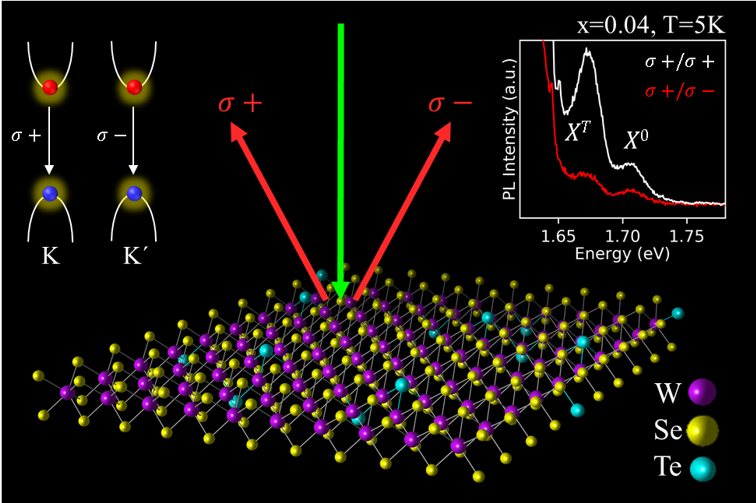
QMC member Dr. Patrick Vora and student Sean Oliver have recently published their work of Valleytronics in 2D Phase Change Materials, Valley phenomena in the candidate phase change material WSe2(1-x)Te2x, doi:10.1038/s42005-019-0277-7, on Communications Physics.
Valleytronics and neuromorphic computing are under heavy investigation as next-generation information processing technologies. In valleytronics information is stored and manipulated by moving carriers between energy band extrema (i.e., valleys) in momentum-space. Achieving this requires a material where carriers can be selectively populated in individual valleys and manipulated on demand. In this work, the team explored the possibility of achieving a single material, e.g. 2D transition metal dichalcogenide alloys, where both valleytronic and neuromorphic functionality can be combined. Their result shows that both valley polarization and valley coherence remain large in their alloy, which also appear to host valley-polarized excitons that are more resistant to phonon-induced depolarization mechanisms. This implies that at elevated temperatures alloys may outperform pure WSe2 in valleytronic applications.
According to Dr. Vora, these results are the first systematic examination of valley properties in 2D phase change materials and point to a new class of devices where valleytronics can be utilized in concert with phase change elements in hybrid next-generation computing architectures.
For more information please see the recent publication in Communications Physics or visit the Vora Lab.
Topic: Polymer Engineering for Creating New Functionalities in Laser-induced Porous Graphene
Location: Johnson Center 337 (Meeting Room G)
Topic: Time‐domain order‐by‐disorder transition in a Harper‐Hofstadter system
Location: Planetary Hall 131

Location: Johnson Center 337 (Meeting Room G)